
Written By:

In many local North Carolina communities, historic buildings and landscapes are getting a second look, and not as artifacts to be frozen in time, but as real opportunities to support modern community life.
Adaptive reuse has become one of the most effective ways to preserve local identity while still allowing places to evolve. This is particularly true in urban settings where efficiency can be achieved with existing infrastructure already in place. Adaptive reuse and historic preservation help communities adapt comfortably to downtown growth.
Too often, preservation conversations focus almost entirely on the building. But the landscape matters just as much. Streets, courtyards, alleys, and open spaces are where the general public usually experiences historic places. These are the spaces that handle accessibility, visibility, natural resource management, and day‑to‑day use. When they’re designed well, they allow historic sites to function comfortably and responsibly in a modern context, without feeling forced or out of character.
The strongest adaptive reuse projects don’t try to recreate a single moment in history. Instead, they respect what came before while quietly integrating contemporary systems, green infrastructure, universal access, durable and sustainable materials, and flexible public space.
The goal isn’t nostalgia. It’s longevity that feels comfortable at the human scale.
Several WithersRavenel projects illustrate how landscape architecture can help historic places remain relevant, usable, and connected to their communities.
The Ivey-Ellington House: Relocation and Renewal
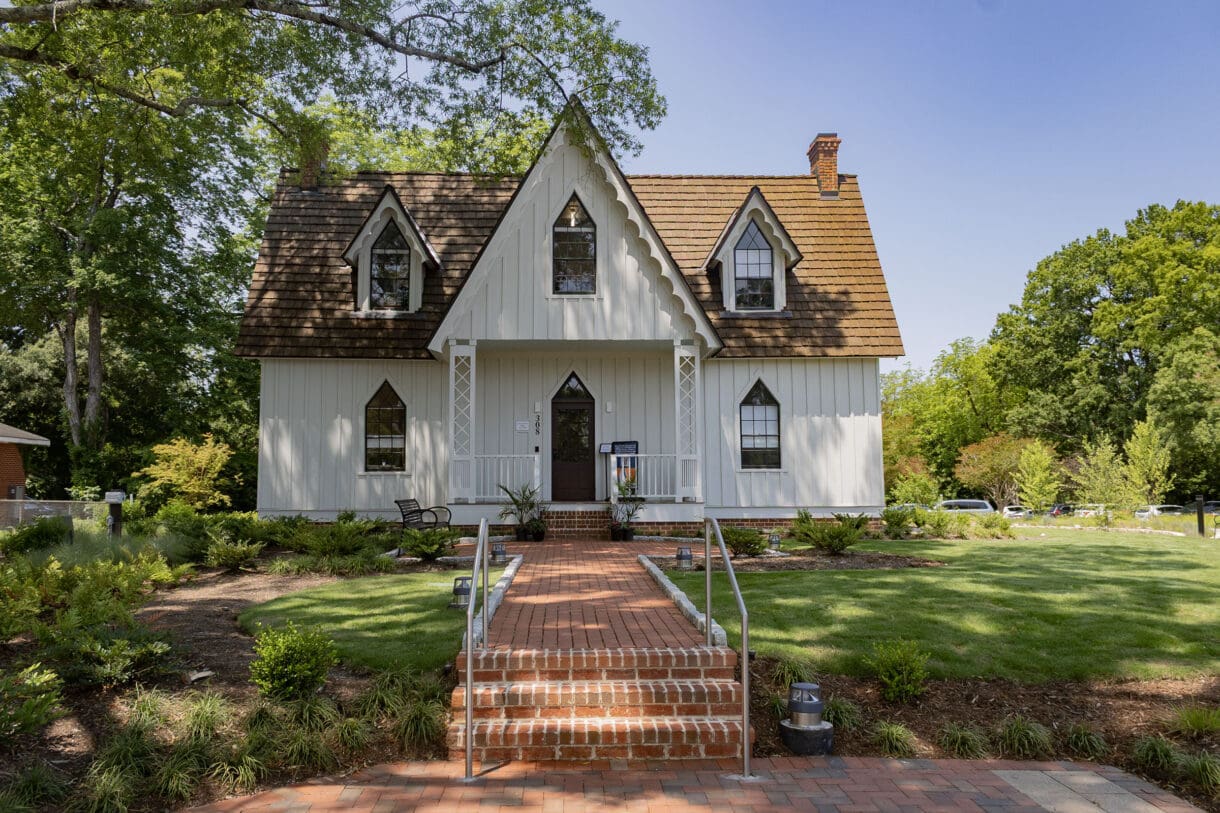
The Ivey-Ellington House is one of the oldest remaining residences tied to the early development of downtown Cary.
Faced with increasing redevelopment pressure, the decision was made to relocate the structure rather than lose it entirely. The house now sits on a prominent civic site adjacent to Downtown Cary Park, highly visible, accessible, and integrated into daily public life. This project is eerily reminiscent of the children’s book ‘The Little House’ by Virginia Lee Burton.
At first glance, the site feels traditional and much like a typical landscape one would find around a house from the 1800’s. But beneath that familiar appearance is a fully modern system. Green stormwater infrastructure in the form of bio-retention and pervious pavers manages runoff and recharges groundwater on-site. Accessible walkways and a discreet ADA lift address a four‑foot elevation change into the building itself without compromising the building’s form.

Durable materials, including composite cedar‑style roof shingles, were selected to extend the life of both the building and the site. The pervious pavers are composed of locally sourced clay bricks, but installed with larger joints on a thick, washed stone base such that they meet the standards of pervious pavement.
The end result is a place that reads as historic and even feels a little bit like stepping back in time, but functions like a modern civic space, quietly resilient, inclusive, and built to last.
Campen Row: From Service Corridor to Festival Street
In many historic downtowns, alleys are treated as leftovers, purely utilitarian spaces for deliveries and utilities. But these narrow corridors often have the scale and enclosure to become some of the most engaging public spaces for people.
In this downtown Wendell revitalization project, a neglected gravel alley, formerly the service yard for a lawn mower store, was transformed into a flexible festival street. What had been an unpaved service corridor is now a pedestrian‑oriented flexible space with plantings, lighting, and practical furnishings.

Today, the alley supports day-to-day parking and loading, while on the weekends, it can close vehicle access and host farmers’ markets, seasonal events, and outdoor dining. On these weekends, it’s filled with people, music, and activity. The anchor of Campen Row is the Bearded Bee Brewery, which is a renovated historic building that used to house the lawn mower store; before that, it was a warehouse used by the adjacent railroad.
The transformation of this downtown space didn’t require large buildings or dramatic, expensive finishes, just thoughtful design to evolve the architecture of the space for modern use.
Some of the design decisions in this renovation included all new paving and re-grading to improve stormwater issues. The overhead network of power lines was all buried, cleaning up the overall look and feel dramatically. Durable paving allows the space to accommodate service access when needed, which includes weekly tractor-trailer deliveries.
Pedestrian zones are composed of brick pavers for easy wayfinding and path identification. Traditional-style light poles replaced the harsh, over-lit scenario that used to support the more industrial prior uses. Today, the historic buildings remain the backdrop while the alley is now one of the most active places downtown.
Siler Station: Rediscovering the Spaces Between Buildings
Adaptive reuse isn’t always about a single structure. Sometimes it’s about recognizing the value of the spaces in between, such as alleys or areas that used to be seen as ‘back-of-house’.
At Siler Station, a group of buildings, more than a century old and forming nearly an entire city block, was redeveloped into a mixed‑use destination. Rather than treating the project as a collection of isolated renovations, the design focused on the connectivity and pedestrian porosity of the whole block.

Former service alleys became pedestrian corridors lined with warm hand-molded brick and overhead lighting, which transformed these spaces into functional outdoor rooms. Small plazas and pocket spaces emerged from areas that had once been written off as unusable. Small areas of softscape were added wherever possible to grow plant material and soften the edges of the spaces.
The design intentionally embraced the irregular geometry of the site. Instead of smoothing out the quirks that come with historic development patterns, those conditions were treated as assets. Corners, nooks, and tight connections now create a layered experience that rewards exploration.
The result is a place where historic texture and contemporary use coexist naturally.
The Carver Community Center: A Historic Rosenwald School Site Reborn
In East Wendell, the former Carver School, a Rosenwald‑era building that once served the local African American community, is being transformed into the Carver Community Center.
The goal is not only to preserve the building, but to transform it such that it continues to serve the surrounding neighborhood in a meaningful way. The site design is central to this effort, as this site will be the epicenter of the historic neighborhood of Pleasant Grove that surrounds it.
The landscape design considers the future in order to make this site a resource for many generations to come, while maintaining fingerprints of the past. Green stormwater infrastructure manages runoff while doubling as a natural resource feature that softens the main parking lot. Outdoor gathering areas support programming, recreation, and informal use.
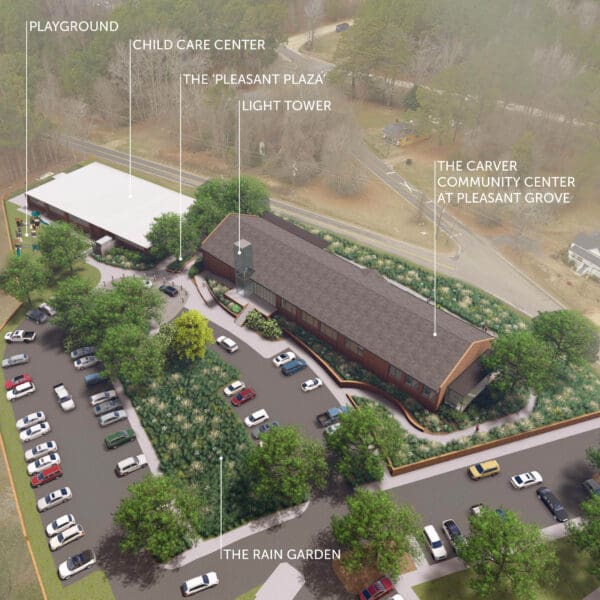
The landscape extends the community center beyond its walls, creating space for events, reflection, and everyday interaction. Intentional off-site connectivity is a major component of connecting the neighborhood to the site. In order to achieve this, greenway width pathways were designed that will ultimately continue outward to connect to the County greenway network in the future. Pedestrian connectivity to the site for non-vehicle users of all ages did not exist for the past 100 years, with only state roads with ditches as the sole means to access the site. Pedestrian connections were considered a key component to provide equal access to the Community center.
For example, providing safe ways for youth to access the community center for after-school programs or during the summer. The most significant pedestrian connection that was made as a part of this project was the extension of the E 3rd Street sidewalk to the site from the West. Previously, the sidewalk, as it left downtown Wendell, ended abruptly when it entered the Pleasant Grove neighborhood. By extending this sidewalk to the Carver Community Center site, this fulfills a critical connection between the site and the downtown core.
Material reuse reinforces the site’s history. Salvaged brick from portions of the existing structure is being incorporated into new landscape elements, including gabion basket walls filled with reclaimed material. These features carry the physical memory of the building forward while giving it a new role in the site.
The result is a landscape that respects the past without being constrained by it, one that supports modern community life while honoring where it began.
Designing the Future Through the Past
Projects like these demonstrate how landscape architecture can bridge history and contemporary needs. With thoughtful design, historic sites can support modern infrastructure, sustainable systems, and inclusive access while retaining the character that makes them worth preserving.
These landscapes don’t just protect history, they activate it. They create places where people gather, celebrate, and participate in daily civic life.
As communities continue to grow and change, resilience won’t come solely from building new places. It will come from re‑investing in existing ones, thoughtfully, carefully, and with an understanding of both past and future.
Landscape architecture plays a critical role in making that happen.
About the Author

Daniel Whatley, PLA
Director of Design
Daniel is the Director of Design for WithersRavenel. He leads a team of urban designers and landscape architects focused on innovative and sustainable design. His background in design, horticulture, and landscape architecture brings a unique perspective and creative design solutions to our projects. He strives to bring people and the natural environment together in a thoughtful manner. He is passionate about the smart growth planning of our urban sectors, green corridors, and open spaces.