
Written By:


Protecting Coastal Communities
You’ve seen the videos: Beach homes, many standing on stilts, collapsing under the force of advancing waves along North Carolina’s coast. These are more than viral moments. In fact, these incidents illustrate a real problem for coastal communities. Encroaching ocean waters threaten livelihoods and ways of life.
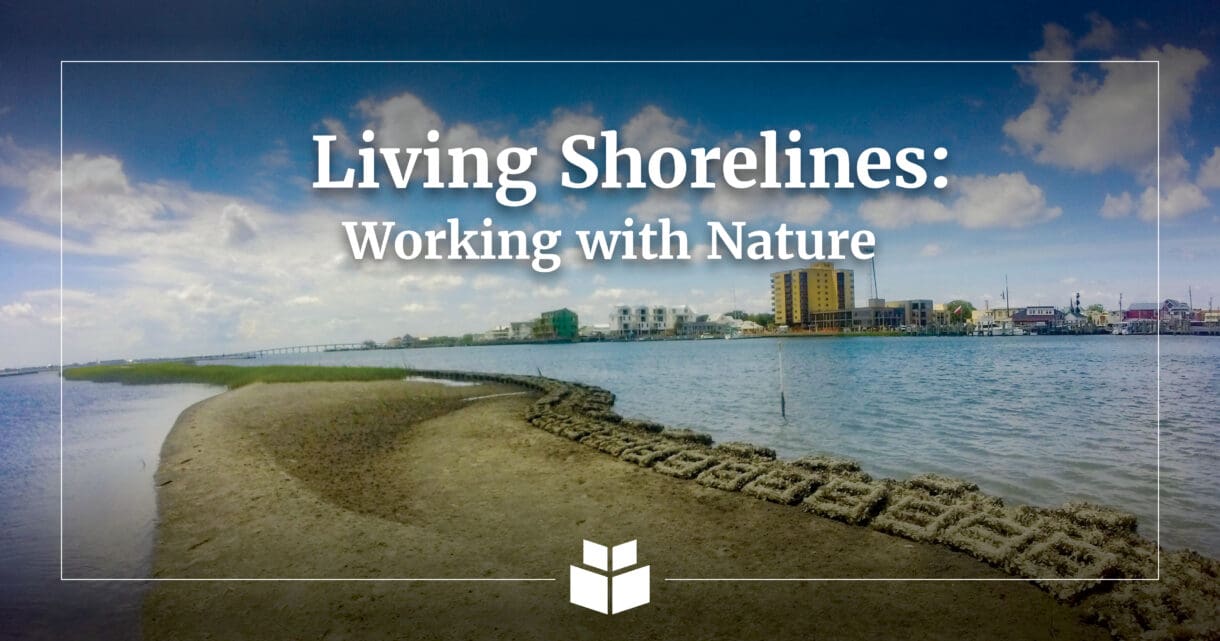
As sea levels rise and erosion intensifies, coastal communities have increasingly sought longer-term solutions to protect themselves. Living shorelines are one of the most effective ways to tackle this unrelenting advance of sea water. The biggest advantage, compared to solutions such as a sea wall or a bulkhead, is the ability of these shorelines to restore ecological health and allow them to thrive.
While living shorelines have gained visibility in recent years, the concept has been in use in North Carolina for a decade. According to WithersRavenel Environmental Scientist Troy Murphy, who is based at our Powells Point location in the Outer Banks, the key shift has been the opening of a permitting pathway.
“Living shoreline type projects have been around for a while,” Troy said. “But the path for obtaining permits and funding for these projects has become more accessible in the last several years than it was previously.”
As permitting and funding pathways improved, living shorelines became a more accessible alternative to traditional hardened shoreline structures.
Read: WithersRavenel adds living shoreline services
Rethinking Hardened Shorelines
Living shorelines can serve as a more environmentally beneficial alternative to traditional hardened structures typically used to protect shorelines. Troy notes there are differences between traditional methods, such as bulkheads and living shorelines.
“Bulkheads typically draw a hard line of where the shoreline will remain once constructed. A lot of times are constructed from vinyl sheeting and timber. … There is a life span to these types of structures, you only get so long before those parts wear out and need to be replaced with years of waves beating against them and wear from salt water.”
Traditional hardened structures serve a purpose and, in certain situations, are the right solution, but many times there are other options available that can help to protect and improve the shoreline.
Living shorelines cost effectiveness
Living shorelines can be more durable and cost-effective over time compared to traditional hardened structures. And they break down wave action more efficiently, Troy said. “The granite’s going to last for far longer than your traditional timber wall. It’s not really going to wear down; it’s going to be much harder. The way these sills are constructed, they absorb and disperse the wave energy, where traditional vertical walls will reflect the wave energy.”
Living shorelines can help to improve a shoreline as opposed to drawing a hardline in the sand. They can also create a more pleasing appearance than their traditional counterparts, despite their higher up-front cost. Nearshore sills, being the most widely used living shoreline type, can help to trap sediments behind the sills and help promote a more natural shoreline that can promote marsh growth and shellfish habitat.
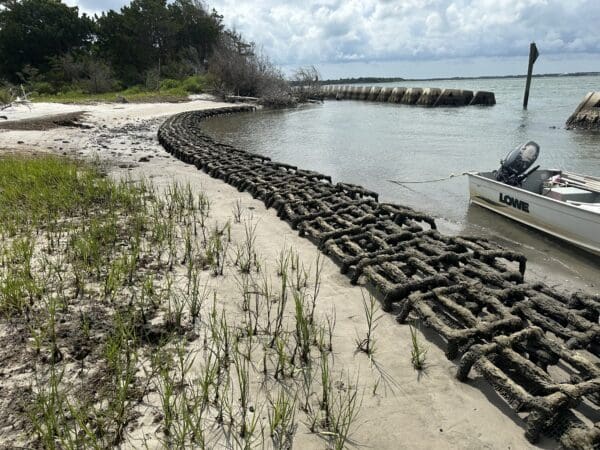
While construction may cost a bit more in the beginning, once plants and marine life habitats get established, you get more “life” out of living shorelines.
There are many different nature-based living shorelines. On some WithersRavenel (previously Quible) living shoreline projects, Troy and the environmental team have incorporated a biodegradable material system called an Oyster Catcher. The product, created by North Carolina’s Sandbar Oyster Company, helps rebuild coastal ecosystems by attracting and eventually establishing oysters. This helps to re-establish oyster reefs, which act as natural filters and natural shoreline protection.
Living shorelines also make good economic sense for local communities as they provide calm (quiescent) areas that help to protect fish larvae and allow juvenile fish to flourish within the calm areas behind the sills. At the same time, they nurture other marine creatures such as crabs and shellfish. Marsh grasses further stabilize sediments and filter runoff, strengthening both the shoreline and surrounding waters.
Designed for North Carolina’s Diverse Coast
North Carolina’s coastline varies widely in wave energy, slope, and geology, and WithersRavenel’s living shoreline designs reflect these differences. “Shorelines can vary a lot from region to region in North Carolina,” Troy noted. For instance, in northeastern North Carolina, shoreline areas may be flatter with a broad coastal marsh. Meanwhile, a project in Camp LeJeune in Jacksonville, NC, may involve high bluff escarpment shorelines along the New River.
Project sizes that the environmental team works on also vary. Anywhere from a 150-foot-wide private home along the sound, or 5,000 linear feet of shoreline along rivers or estuaries. Application of living shorelines can look different depending on the region and water body they are proposed.
Permitting and Grant Funding Opportunities
Permitting typically involves going through the Coastal Area Management Act (CAMA) Major permit process for larger-scale projects. Smaller-scale projects (500 linear feet or less) may be permitted through a CAMA General Permit if they meet certain criteria. CAMA Major permits are a joint federal and state permitting effort. The North Carolina Division of Coastal Management (NCDCM), a part of North Carolina’s Department of Environmental Quality (NCDEQ), leads this permitting.

Since permitting pathways have become more accessible and the success of these living shoreline projects has become more widely known, funding options have become more readily available. “There are a lot of funding options out there,” Murphy says. “Groups like the Land and Water Fund provide funding for many of these projects. As well as organizations and agencies such as the National Fish and Wildlife Foundation (NFWF) and USDA’s Natural Resources Conservation Service (NRCS).”
Grant-funded projects can take longer due to application and review cycles, but multiple opportunities are often available. “Sometimes one (grant) doesn’t work out,” Murphy adds, “but since there are options, there are other opportunities available.”
Be it a homeowner with a sound front property, a seafood producer, or a conservation organization looking to stave off environmental damage, living shorelines offer one of the best options against erosion along coastal environments.
“Once living shorelines are installed and the system begins to naturalize, they will eventually improve water quality and biodiversity, which is going to help local fisheries and communities.”
Featured Projects


Want to learn more about Living Shorelines? Let's connect!

About the Author
Troy Murphy