
Lifecycle model prompted Kannapolis to expand pavement repair options and bulwark level of service
The City of Kannapolis, North Carolina, had landed on a simple and familiar pavement management strategy for the community’s 224 centerline miles of roadway. They conducted regular pavement condition surveys, repaired streets that could be fixed, and replaced streets that couldn’t. But with a budget of around $700,000 annually, the average condition of their pavement wasn’t very good. They needed a way to stretch their dollars further until they could make a bigger investment.
Because of a pavement lifecycle model, the City of Kannapolis saw an opportunity to expand their portfolio of repair options to include an economical alternative to their usual pavement rejuvenator method.
An introduction to the perpetual pavement model
The City of Kannapolis follows the perpetual pavement model of pavement management. In the perpetual pavement model, the goal is to maintain the riding surface of the road for as long as possible because it protects the base and subbase of the road, which are much more expensive and disruptive to fix. By making smaller, recurring investments in the riding surface, communities can preserve the road quality for drivers and dramatically reduce how often they need to pay for expensive reconstruction projects.
An example maintenance schedule for perpetual pavement might look like this:
- Year 0: Construct a new road
- Year 1–4: First application of rejuvenators to replenish the maltenes (oils) that keep the asphalt from becoming brittle and prevent water from penetrating to the base and subbase
- Year 6–9: Second application of rejuvenators
- Year 11–14: First application of a thin-lift overlay such as a micro surface, slurry seal, or cape seal
- Year 16–19: Second application of a thin-lift overlay
- Year 21–26: No more treatment options; road must be replaced via mill-and-overlay when end of life is reached
In years when a larger treatment isn’t scheduled, patching may be necessary to target cracks or potholes.
Kannapolis had a tiered system of pavement treatment options
The City of Kannapolis’s pavement management strategy involved five treatment types based on the pavement condition index (PCI) score of the roadway segment. These treatment types range in cost from $1 per square yard to $100 per square yard and extend the pavement life by four to twenty years.
City of Kannapolis Pavement Treatment Options with Costs and Benefits
| Maintenance Activity | Unit Cost | PCI Range | Segment Life Extension (Years) |
| Preservation – Prevent (Rejuvenator) | $1.00/SY | 82–100 | 4 |
| Patching (5” Full-Depth Asphalt) | $100.00/SY | 85–100 | 15 |
| Preservation – Correct | $10.00/SY | 65–81 | 7 |
| Rehabilitation (Overlay) | $30.00/SY | 30–65 | 17 |
| Reconstruction | $45.00/SY | 0–30 | 20 |
The City budget couldn’t maintain service levels for the next 30 years
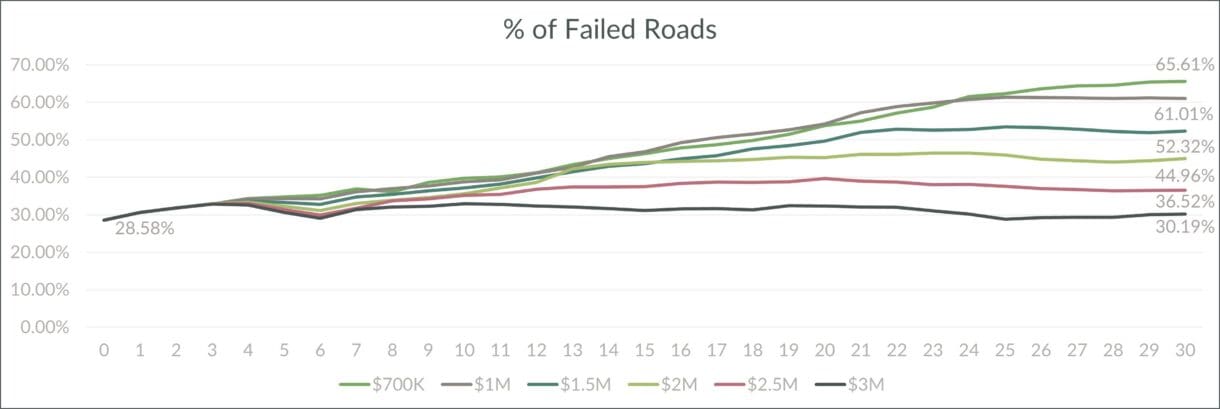
Kannapolis invested about $700,000 per year into roadway repair and reconstruction projects. In 2022, their average PCI was 45.97. City staff wanted to understand how maintaining that budget would affect the quality of their roads over the next 30 years.
Using a pavement lifecycle model, WithersRavenel showed two critical outcomes of keeping the same budget:
- Average PCI would drop from 45.97 to 30.16
- Percentage of failed roads (PCI = 0) would rise from 28.58% to 65.61%
Simply put, maintaining their budget would not allow the City to maintain their roads.
Increasing the pavement treatment budget would be ideal, but would also take time
The most effective strategy for improving the City’s average PCI and reducing the backlog of failed roads would be to increase their budget.
Raising the annual investment to $1.5 million would allow them to keep their average PCI about the same over 30 years—in fact, raising it slightly from 45.97 to 50.35—but their percentage of failed roads would also increase from 28.58% to 52.32%.
Raising the annual investment to $2 million would allow them to increase their average PCI from 45.97 to 60.65 and curb the increase in percentage of failed roads to only 44.96% by the end of 30 years.

While the City would like to make a substantial budget increase, it’s often not feasible to do so in one fell swoop. Budget increases may need to happen incrementally over several years as the City reallocates funds from other sources or seeks new revenue streams. In the meantime, staff wanted to know what they could do to stretch their dollars further.
A new-to-Kannapolis preventive treatment option would reduce the need for more costly repairs
WithersRavenel recommended the City add crack sealing to their pavement treatment options. Crack sealing is appropriate for light transverse cracking, and it costs only $0.85 per square yard to apply. This is less than one-tenth the cost of the treatment for moderate transverse cracking, and less than one-fortieth the cost of the treatment for severe transverse cracking, making it much more cost effective than waiting for the road to deteriorate to do a more intensive treatment. The money saved from this preventive maintenance could be applied to other roadway segments needing repair or rehabilitation.
Crack sealing also prevents potholes from forming and extends the life of the roadway by up to four years. Adding it to the City’s treatment program would ensure roads with a “Good” condition rating keep their rating while the City slowly increases their investment.
The bottom line
For Kannapolis, an ounce of prevention is very much worth a pound of cure. By adding crack sealing to their treatment program, the City can pay a relatively small upfront cost to extend the service life of their roads and use the savings to pay for more roadway improvements each year.