
Written By:

What is Subsurface Utility Engineering?
Subsurface Utility Engineering, or SUE, is a valuable tool when planning and executing public infrastructure projects. Finding underground utilities and materials helps with project design. SUE also keeps people safe and can avoid expensive costs and delays.
Jonathan Nichols is the SUE Director at WithersRavenel. With over 15 years of experience, he offers a variety of SUE services for clients. He helps with infrastructure projects and assists communities in understanding their utilities and materials.
What’s above the ground comes first
There are four different Quality Levels of Subsurface Utility Engineering: D, C, B and A. Each level after D includes the services of the previous levels.
What is SUE Quality Level D?
Level D is records research to provide an understanding of the existing information for a municipality or, more specifically, for a project area.
SUE technicians gather the available information from all utility owners in the area, like the cable company or municipal water and sewer. Jonathan says when records are sparse, this may also involve interviews with workers who may have specific knowledge.
What is SUE Quality Level C?
Level C involves going into the field to survey all the above-ground utility structures, whether that is utility poles, hydrants, valves, or other features. Then all this information is transferred onto a map, which can be shared with a client.
An example of where Level C may be enough for a client, Jonathan said, would be designing a force main in a right of way.
“If you know the gas and the water are on the left side of the road, and you just have telephone lines on the right side of the road, you would want to try and design the sewer force main on the right side to try to avoid utility conflicts,” he said.
Level C can also provide a starting point for small towns with limited or no municipal records of their utility infrastructure. Understanding what is in the ground and when it was installed can provide details on the materials used. It can also show how much longer they are likely to last before needing replacement.
“And then we can ask them, what is your next step?” Jonathan says. Subsurface Utility Engineering information can also provide critical design details to inform funding applications for infrastructure projects.
What is SUE Quality Level B?
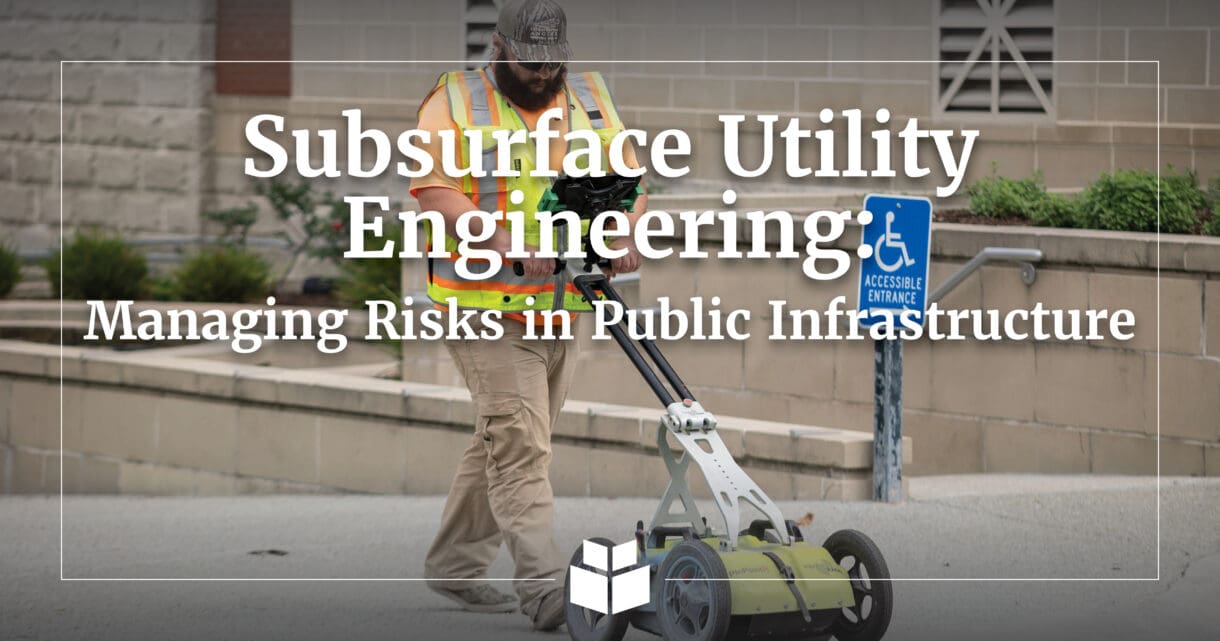
SUE Quality Level B is the next step. WithersRavenel technicians go into the field with electromagnetic and Ground Penetrating Radar (GPR) equipment to accurately designate underground utilities throughout the project area. Paint marks indicate where these utilities are within the field, then surveyed, using Conventional Survey methods, to accurately depict the utilities within AutoCAD, Microstation, ORD, or other drafting platforms. Clients then have an accurate horizontal map of all the utilities within a certain project area. Jonathan says the majority of WithersRavenel SUE projects advance to Level B.
What is SUE Quality Level A?
SUE Quality Level A is the most accurate, intensive SUE standard.
Jonathan said Level A arises when engineers and designers know that, for example, a new water line or force main will be in close proximity or even crossing other utilities, such as a gas line. When you need to know the exact vertical location of a utility, only Level A will do.
In this step, WithersRavenel technicians perform Vacuum Excavation to uncover the target utility and provide information such as size, depth, material, and condition.
To follow the ASCE Accredited SUE process, SUE Quality Level A would follow the horizontal mapping performed in SUE Quality Level B. The true SUE process is, again, compounding as you work from Quality Level D to Quality Level A.
Saving money, saving time, saving lives
Some municipalities may think, “Why do I need Subsurface Utility Engineering?” North Carolina (NC) 811 provides some information, and our existing records may be dated, but does that really matter?
Jonathan acknowledges that SUE comes with an upfront cost, but the benefits outweigh the expense. With the growth in the Triangle and the state, there are now more fiber optics and utilities underground than ever. One utility that is damaged or cut could be an expense that runs into the hundreds of thousands of dollars. Compound that cost with the expenses related to project delays and redesigns, and the number keeps growing. And that is not even counting the potential human toll.
“Any kind of power or gas line, now you’re talking about people’s lives,” Jonathan said. “What you’re getting for your SUE investment is not only cost security in your project when it comes to design, but you’re also keeping people working in the field safe.”
SUE as a valued service
Academic studies on SUE illustrate its value as a service, Jonathan pointed out. Research at Purdue in 1996 found that for each dollar invested in SUE, the return on investment averaged $4.62. Researchers compared projects in North Carolina and other states. They looked at projects that used SUE and those that did not. They found that conflicts and delays from unexpected underground utilities were much higher than the initial SUE costs. In 2025, Jonathan said the return on investment has likely doubled. Rising construction costs and inflation are the main reasons for this. Additionally, there has been a large installation of fiber optics since the 1990s and early 2000s.
Jonathan hopes that Subsurface Utility Engineering will be an educational path in trade schools. He also wants a licensing standard to be created. In the meantime, he is committed to continuing to explore technological advances and service growth at WithersRavenel.
Are you looking into SUE services for your next infrastructure project? You can reach Jonathan at 919-238-0367 or jnichols@withersravenel.com.