
April is World Landscape Architecture Month and marks what would be the 200th birthday of the father of modern landscape architecture, Frederick Law Olmsted.
Olmsted, born on April 26, 1822, is best known for his design of New York’s Central Park and, here in North Carolina, the grounds at Biltmore Estate in Asheville. Prior to becoming a landscape architect, Olmsted was a traveler, farmer, and journalist. He was a member of the Sanitary Commission during the Civil War, where his focus on clean water, food, and sanitary conditions saved the lives of hundreds of soldiers. He also wrote about North Carolina and Raleigh in his Papers Slavery and the South1852-1857.
The Niagara Reservation
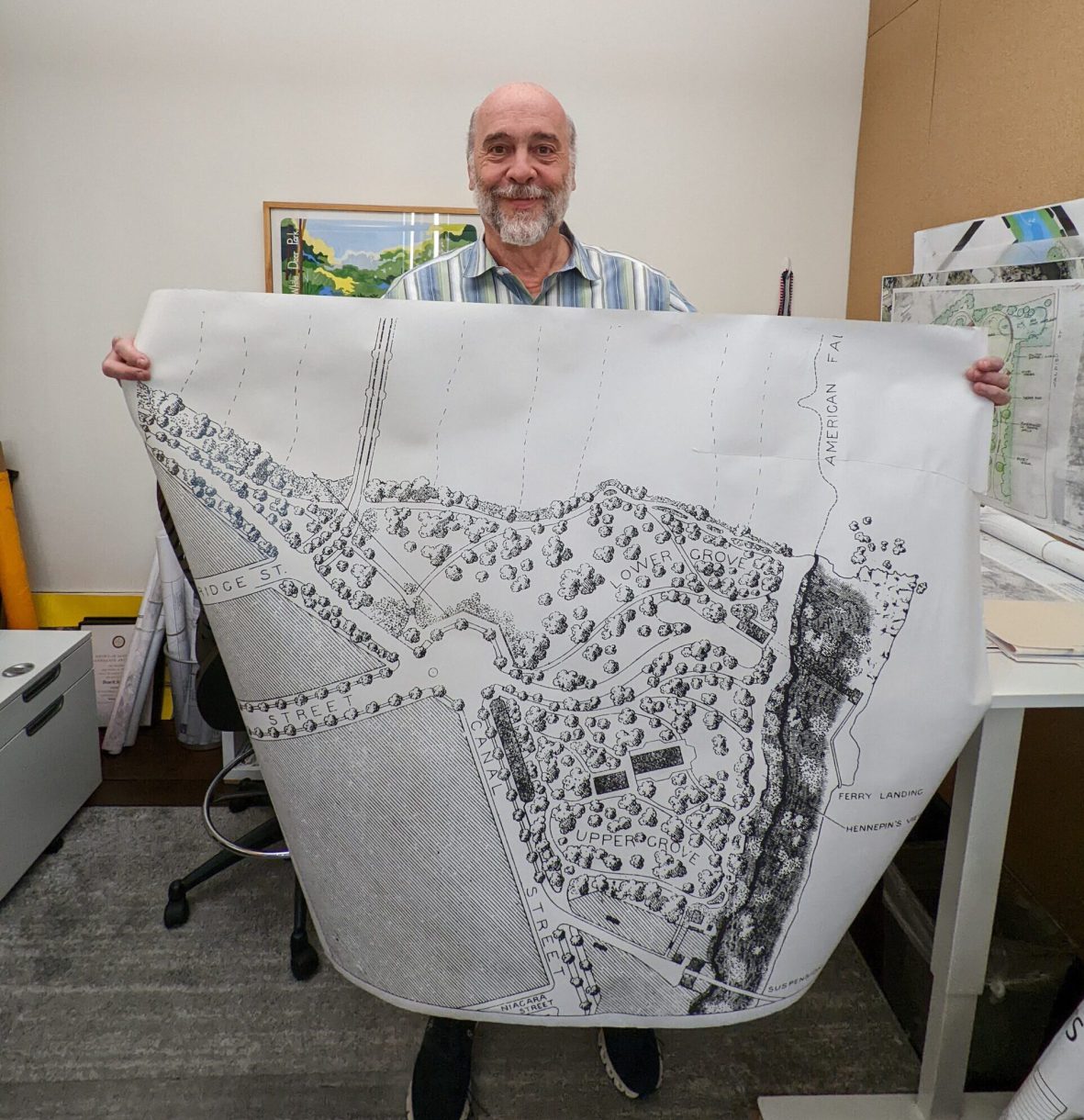
The reservation is a narrow strip of land along the eastern shore of the Niagara River in New York, and at the brink of the American side of Niagara Falls, including a grouping of islands situated in and between the American and Canadian falls: Goat Island and Three Sisters Islands.
Niagara became a reservation in 1885. The guidelines that promoted public ownership were put forwarded in a special report in 1879 by Olmsted, and James T. Gardiner, State Surveyor. The efforts of many, including Architect HH Richardson, Painter Frederic Church and other preservationists over sixteen years led to its protection, reclaiming it from industrial development along the river’s banks.
In 1887, Olmsted and Calvert Vaux implemented the 1879 plan, which established scenic roads, walks, promenades, seating, and managed views at important picturesque points to enhance the public’s experience while protecting the natural character of the area and screening out views of the city in the distance.
In 1962, the Niagara Parkway, a four-lane divided highway was built through the reservation by Robert Moses separating the city of Niagara Falls from the falls itself. Two stone pedestrian overpasses were necessary to get visitors from the city to the falls.
Landscape Architects at WR were schooled on Olmsted’s work, of course and the influence of his work in ours is undeniable. For WithersRavenel Parks and Recreation Director Brian Starkey, a direct connection to Olmsted’s work came early in his career.
Brian’s Connection to FLO
From 1982-1985, Brian was a young designer working for Cannon Design in Buffalo, N.Y. The firm won a project to design a new interpretive center at the State Reservation of Niagara, the first state park in the nation and one of Olmsted’s projects. Brian led the site design working closely with project architects.
It’s probably the most visited landscape I’ll ever work on and because it was an Olmsted landscape, I felt an obligation to be true to his original vision, Brian said. In addition to the center, the project team saw an opportunity to undo some improvements made over the years and help restore the reservation back to that vision. This is where Brian really got engaged.
His first assignment: travel to Washington, D.C., pore through Olmsted’s papers in the National Archives, and find information on the 1879 plan. He spent three days researching the creation of the reservation, Olmsted’s advocacy, and his plan for converting private industrial land into public park space.
Getting to go to the national archives and do that research was a big thing for me as a young designer, he said. “I found everything from sketches, photographs, and pages of written descriptions on design approach, to lists of plants Olmsted planned to use on the reservation.”
We restored a lot of the park fabric included in Olmsted’s original plan, such as the braided pathways along the river, Brian said, but equally gratifying was removing the parkway. In addition to the interpretive center, the design team also removed a large parking area, created the Great Lakes Garden, and redefined the landscape in the front of the administration building.
Being involved in the reservation project was a formative experience for me, Brian said. There were so many lessons. I remember wondering throughout the design, ‘Am I doing the right thing? Am I being true to the original vision?’ It was kind of a WWFD (What Would Fred Do?) measurement of our design decisions. ‘Olmstedian’ principles are present in much of my work and that influence is rooted in the Niagara Reservation project.”
The issues Olmsted addressed through his work over a century ago are still relevant today. Our WR team of Landscape Architects celebrate Olmsted’s legacy every day, connecting us to nature and designing equitable public spaces.
The WithersRavenel team on Olmsted
Today, WithersRavenel’s landscape architects also believe in the healing properties of public spaces, and in the legacy of Olmsted. Here’s what some of our designers have to say about the father of landscape architecture.
Attending art school in Baltimore, Maryland, and being surrounded by Olmsted’s parks and greenways shaped my desire to become a landscape architect.– Courtney Landoll, Director of Landscape Architecture
As I grew into my profession as a landscape architect, I began to appreciate and incorporate Olmsted’s ideas of the genius of place and designing for the unconscious. I have learned to appreciate the spirit of a place,or genius loci, and let it infuse and guide my design decisions. I also try to unconsciously guide people through a landscape or through a space without them realizing that they are being led and allowing them to experience the landscape environment as a whole and not a sequence of parts.” – Gary Warner, Practice Area Leader
Frederick Law Olmsted is a beloved figure, particularly among Landscape Architects. Many people focus on the design processes of Landscape Architecture that he pioneered, but to me his power was much greater. Olmsted made gardens and landscapes important. At a time in our history when land was being swallowed for industry, he inspired powerful people to build legendary gardens, parks and park systems across the country. He successfully spoke for Nature and its importance to human life, and the results are iconic landscapes that our cities have been built around. People treasure New York’s Central Park, Boston’s Emerald Necklace, Asheville’s Biltmore Estate, the United States Capitol grounds, and hundreds of equally significant projects. Now, 200 years later, we find ourselves in a similar predicament as development swallows our lands and we feel the effects of climate change. Landscape Architects are pushing the ideas of green infrastructure, placemaking, urban renewal, and restoring our native ecological systems. I’m hoping that many of them are able to channel Olmsted’s powerful voice and ability to inspire.” – Dan Greenberg, Landscape Architect
Additionally, the American Society of Landscape Architects is celebrating Olmsted and his legacy in April. The website Olmsted200.org champions his overriding belief that parks are for everyone and that their presence in urban environments is particularly vital. Visit the site to celebrate his living legacy. If you would like to learn more about his work in North Carolina, view more information on Olmsted’s work on the Biltmore Estate in Asheville.