Written By:

Public Works Decisions Need a Clearer Story
Public works leaders are often asked to explain decisions that are complex, technical, and constrained by limited resources. In a council meeting, budget conversation, or community forum, the questions can come quickly:
- Why this road?
- Why now?
- Why not that project instead?
These are fair questions, but they are not always easy to answer in a way that connects with elected officials, finance teams, and residents. Public works professionals may have the data, experience, and technical understanding behind their recommendations, but that does not always mean the story is easy to tell.
That is where lifecycle planning can help.
Lifecycle planning gives communities a clearer way to connect infrastructure asset management, funding needs, service expectations, and long-term outcomes. It helps public works leaders move beyond simply identifying infrastructure needs and toward telling a more complete story about priorities, timing, risk, and consequences.
Rooted in Service, Powered by Better Decisions
This year’s National Public Works Week theme, “Rooted in Service, Powered by Community,” speaks directly to the work public works professionals do every day. Some of that work is highly visible, such as roads, bridges, sidewalks, parks, and public facilities. Other contributions, including water, sewer, stormwater, and maintenance systems, are often hidden from view until something goes wrong.
Lifecycle planning helps bring that full picture into focus. It gives public works leaders a way to communicate how both visible and unseen infrastructure support the daily life of a community. It also helps show how today’s decisions can strengthen the systems residents depend on tomorrow.
For WithersRavenel’s Craig Roach and Keith Pugh, PE, that connection between infrastructure data and public communication is central to helping communities make better decisions. Roach works with local governments to modernize operations and implement technology-driven solutions that improve service delivery, transparency, and efficiency. Pugh, a former National APWA President, brings more than 30 years of municipal engineering and public works leadership experience, helping communities navigate the realities of infrastructure planning, funding, and public decision-making.
Turning Infrastructure Data Into Decisions
“The next wave of government innovation isn’t more data,” Roach said. “It’s using what you already have to make better, clearer decisions for your community.”
Many communities have already taken important first steps. They have asset inventories, condition assessments, GIS data, inspection records, and maintenance histories. These tools provide an important foundation, but having data does not automatically make decisions easier. A community may know which roads are in poor condition, which pipes are aging, or which facilities need investment. The harder question is how to turn that information into a clear explanation of priorities, timing, tradeoffs, and funding needs.
That is where many communities find themselves: data-aware, but still working to become decision-driven. Lifecycle planning helps bridge that gap by connecting asset condition, service expectations, and funding over time. It helps communities explain not only what needs to happen, but why it needs to happen now and what the consequences may be if action is delayed.
From Data-Aware to Decision-Driven
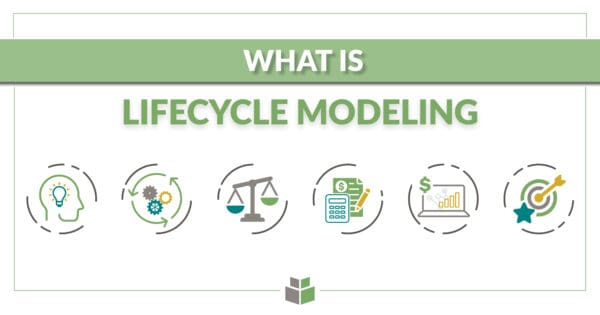
At its core, lifecycle planning is about identifying the most cost-effective long-term strategy for maintaining an asset at a desired level of service. Another way to think about it is the total cost of ownership.
Instead of asking only, “What do we need to fix this year?” lifecycle planning asks, “What is the best long-term strategy for managing this asset over its entire life?”
That shift matters because infrastructure decisions are rarely one-year decisions. A road, utility system, stormwater asset, or public facility may require different levels of maintenance, rehabilitation and replacement over many years. A decision made today can affect future costs, service levels, and risks. Lifecycle modeling helps communities look beyond the immediate repair and understand the long-term impact of their choices.
Communities often move through several stages as lifecycle planning becomes more useful. While some are data-aware, others are story-seeking, where leadership is asking better questions and staff need clearer explanations.
Some communities become decision-driven, using lifecycle information to compare funding levels, evaluate outcomes and balance risk. A smaller group has fully operationalized lifecycle planning, using it to guide budgets and infrastructure decisions year after year.
Making the Tradeoffs Visible
The point is not for every community to jump immediately to the final stage. Most communities start somewhere in the first or second stage. The opportunity is to understand where lifecycle insight can help support better decisions today and where the organization can begin building a more repeatable process over time.
Public works decisions often involve competing priorities. A community may have several projects that are technically justified, but not enough funding to complete them all.
One asset may be in worse condition, while another may carry a greater risk if it fails. One project may be more visible to the public, while another may be more urgent from an operational standpoint.
Lifecycle planning helps make those tradeoffs visible before decisions are made.
This changes the nature of the conversation. Instead of debating which project feels most urgent, communities can compare likely outcomes.
- What service level will current funding deliver?
- How will asset performance and risk change under different investment levels?
- What funding level is required to reach a target condition?
- What long-term financial impact will new development create?
These are not just civil engineering questions. They are leadership questions, budget questions and community questions.
Connecting Public Works, Finance, and Leadership
When public works, finance, and leadership teams are looking at the same information, the conversation can shift from opinion to options. Lifecycle planning does not replace professional judgment, and it does not require perfect data. It is not a crystal ball. What it does is give communities a clearer way to connect infrastructure actions to funding outcomes.
Keith has seen this challenge from both the technical and leadership sides of public works. Communities often want to do the right thing, but they are balancing limited funding, public expectations, political realities, and day-to-day operational demands. That is why the way information is communicated matters.
As Keith has noted in conversations around asset management, “New infrastructure starts to degrade from day one.” That perspective is central to infrastructure asset management because every new road, facility, utility, or public asset brings future operations, maintenance, repair and replacement needs.
A Better Way to Communicate Infrastructure Needs
For public works professionals, clarity matters. Their work is not only about maintaining infrastructure, but it is also about helping communities understand the value of their assets and the consequences of underinvestment.
That work is rooted in service because it is focused on protecting the systems people rely on every day. It is powered by community because those systems connect people to jobs, schools, homes, businesses, recreation, and essential services.
During National Public Works Week, it is worth recognizing the role public works leaders play in telling that story. Lifecycle planning gives them another tool to make the story clearer, more transparent, and more defensible.
Next in the Series
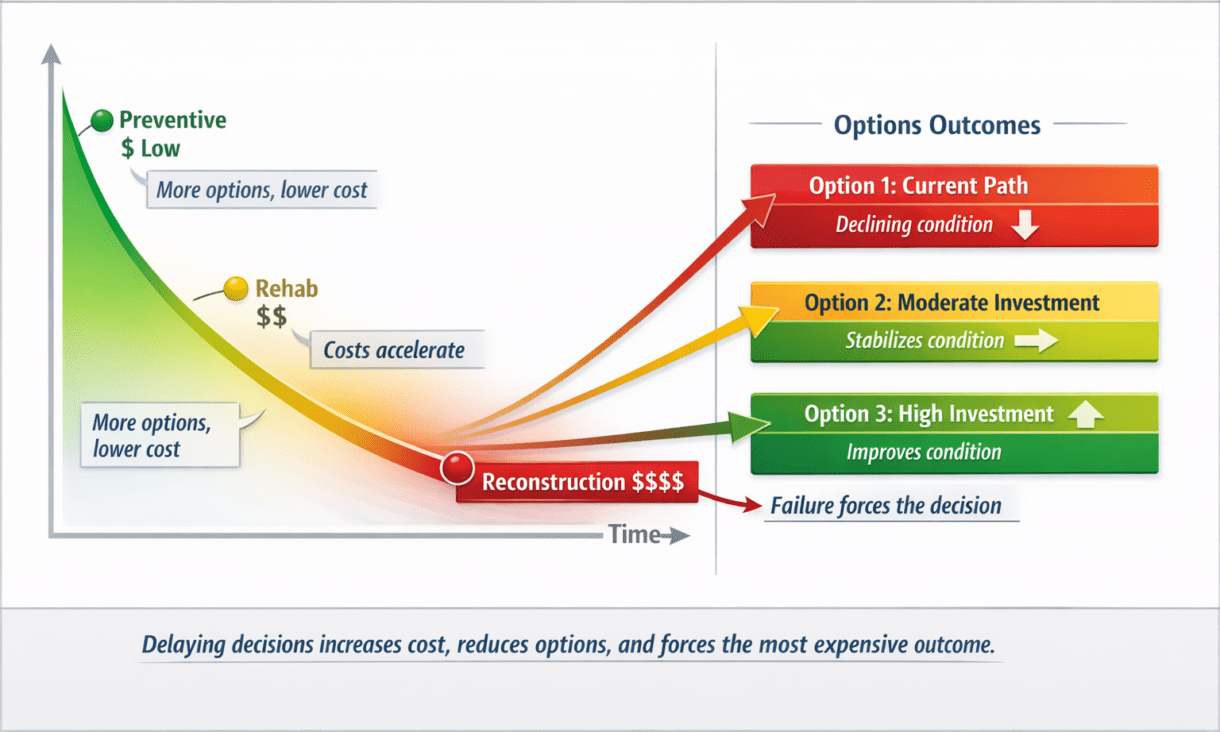
In the next article in this series, we will look at one of the biggest reasons lifecycle planning matters: deferred maintenance. When infrastructure decisions are delayed, communities do not simply push costs into the future. They can lose options, increase risk, and turn manageable maintenance needs into expensive reconstruction projects.
Want to Learn More About Lifecycle Planning? Let's Connect!