

Written By:

Artificial intelligence is no longer a future-state conversation for the architecture, engineering, and construction (AEC) industry. It is already changing how firms organize knowledge, develop proposals, support project delivery, evaluate information, and make business decisions.
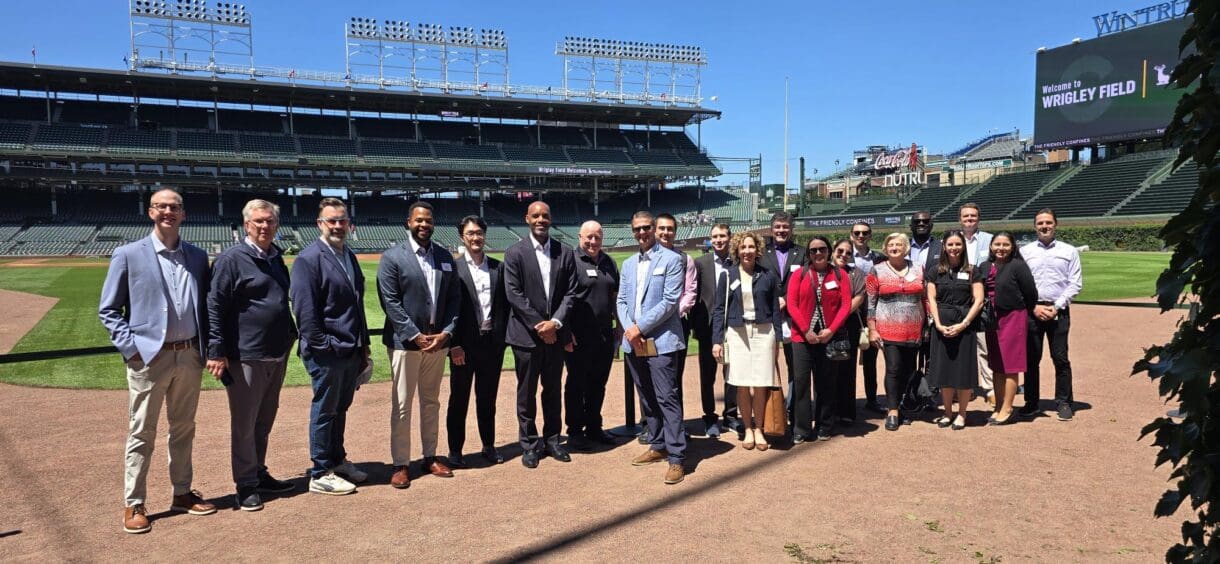
At the J.P. Morgan Professional Services Forum at the Wrigley Field Event Center in Chicago, I joined Brigitte Coles, Leader of Agentic Transformation and Value Creation at West Monroe, for an AI panel discussing the barriers and solutions to real AI adoption, integration, and scalability.
For us, the question is no longer, “Should we use AI?”
It is: How do we use it responsibly, practically, and at scale?
Recognize That We Are Playing a Different Game
AI is not simply another software upgrade or another tool. It is changing the game, and the rules are still being written.
During the panel, I referenced Kyle Shannon’s framework, “The 7 Economies,” which describes the paths individuals and organizations may choose to take and the resulting business impacts. Some will ignore the change. Others will experiment around the edges or use AI to optimize familiar processes. Still others will surround themselves with agents and redesign how work gets done.
The organizations that create separation will recognize that we are playing a different game, with different players and different rules, and then deliberately learn and choose their path.
There is no wrong answer, but my thoughts are more along the lines of a great quote from Back to the Future: “Roads? Where we’re going, we don’t need roads.”
Think about what your business was 30 years ago, then 10, then five, and compare that with today. Almost all of us have evolved in some capacity. At a minimum, we need to understand the idea behind Marshall Goldsmith’s well-known phrase: “What got us here will not get us there.”
AEC firms have spent decades building successful processes around professional expertise, technical standards, quality control, project management, and client relationships, often while using the same fairly static enterprise software platforms for decades. Those foundations remain important, but we cannot assume every established workflow should or will remain unchanged.
A great example is earthwork calculations by hand. Who primarily does that today? Almost no one. Who regularly uses hand calculations to check software outputs? Rarely. Over time, we built confidence in the software. Today, we generally trust its outputs, supported by our professional experience and judgment.

AI may follow a similar path, but trust should be earned through testing, validation, and defined review standards. Because adoption is moving quickly, firms need to build those controls sooner rather than later.
We need to ask ourselves what path we want to take, personally and as firms, then embrace the resulting culture and adjust our business plans accordingly.
For those who want to integrate AI more vigorously, especially internally, which is a good place to start, we have to understand our data landscape and capabilities. Where is information trapped? Where does repetitive work consume valuable time? Where is institutional knowledge concentrated in a few experienced employees? Where could technology support better decisions?
Then we need to prioritize those opportunities and implement them with focused technical and business staff.
The goal is not to add AI to every task. The goal is to understand where it can create meaningful value.
Treat AI, or Really LLMs, Like an Intern, Not an Expert
One of the biggest mistakes I have seen is assuming that a large language model (LLM) provides a definitive answer because its response sounds polished, confident, and positive. You know the response: “Your answer is perfect…”
LLMs are probabilistic, not deterministic. They generate likely responses based on patterns, context, and the information available to them. They do not inherently understand your organization, verify every fact, or transform unreliable source material into reliable information. They will also take liberties if they are not given specific instructions and focused data.
That distinction is particularly important for civil engineers and other licensed professionals whose work depends on accuracy, sound judgment, documentation, and public trust.
I recommend treating AI like an intern. Give it a clearly defined role. Explain the assignment. Provide relevant instructions, context, and examples. Ask follow-up questions. Then review, correct, and refine the result.
Be curious and challenge the outcomes.
AI can help teams move from a blank page to a useful starting point. It can summarize lengthy documents, particularly when given specific instructions and guidance, organize research, develop and improve draft communications, assist with proposals, identify patterns, and generate creative approaches to a problem.
But humans must remain involved in building, testing, revising, managing, and directing the process.
Trust, but verify.
That principle has been consistent throughout my conversations with AEC leaders, including the practical applications discussed in “4 Strategic Takeaways on AI Adoption in AEC.” AI can support the work, but it does not and cannot replace accountability for the outcome.
Data Classification Creates the Foundation
Firms cannot responsibly scale AI without understanding their data: its connectivity, quality, location, type, quantity, classification, and security.
Employees need clear guidance for distinguishing between public, internal, confidential, proprietary, client-controlled, and restricted information. They also need to understand which information can be entered into an AI platform, which tools have been approved, and what protections those platforms provide.
The wonderful and often unheralded people in IT absolutely should be the go-to resource for developing, tracking, auditing, and approving the tools and processes used to leverage data responsibly.
However, project managers, engineers, planners, designers, marketers, financial teams, executives, and anyone else using organizational or client information also share responsibility for implementation and the protection of sensitive information.
One way to assist with this is through enterprise LLM platforms, which can provide a more secure environment for adoption, particularly when they align with a firm’s existing technology ecosystem. It can be especially helpful to use enterprise LLMs that integrate with your existing platform. If you are a Microsoft shop, for example, that may mean Copilot. For Google, it may mean Gemini.
However, the tool alone does not create responsible use. Firms still need education, policies, oversight, and a culture in which employees feel comfortable asking questions.
Governance is not the opposite of innovation. Done well, and simply, at least for the user, governance allows innovation to scale.
This was also central to my session at the 2025 ACEC Fall Conference, where the discussion focused on using LLMs across proposals, design workflows, and project delivery while protecting sensitive client and organizational information.
Is Capturing ROI a Dream? Activity Is Not Impact
Another challenge for AEC leaders is determining whether AI adoption is producing meaningful, tangible results.
Usage data can show how many employees opened a platform, entered a prompt, or summarized a document. Those numbers may demonstrate interest, but activity is not impact.
The more important questions are whether AI reduced time spent on a recurring process, improved the quality or consistency of a deliverable, reduced rework, provided faster access to institutional knowledge, or allowed a highly skilled professional to focus on higher-value technical and client work.
Return on investment remains difficult to calculate for many organizations because they are still experimenting. And, honestly, many firms do not track their current processes and tasks well enough to have strong baselines to work from.
Firms may need to invest in building those benchmarks as soon as possible while also focusing on data readiness, governance, training, workflow redesign, and technical talent before the larger benefits become visible.
In the meantime, we can track more subjective feedback, such as client and employee experience, especially around projects or processes using AI. Again, it helps to have a benchmark before you start.
Even the technology leaders are still developing insights and evidence-based research around ROI. Google recently launched the first iteration of its AI & Economy ATLAS, or Activity, Task, Landscape, and Adoption Study, an ongoing large-scale effort examining how people are using Google’s AI products and tools.
As a side note, the study found that much of AI use is still focused on assisting rather than automating work, with a significant amount of use occurring outside the workplace.
Even though ROI is challenging, find metrics you understand and track something rather than allowing perpetual experimentation. We will gain confidence and a better understanding of ROI as the industry adopts AI, but we need our front office, back office, and delivery teams to provide the reporting and feedback necessary to identify what is meaningful.
Don’t let AI be implemented simply because it is available.
Move Beyond Perpetual Piloting
Giving employees access to an AI tool is not an AI strategy.
Neither is encouraging experimentation without providing direction, education, dedicated learning time, or a way to share what works.
Most importantly, carve out time for the people who are interested in AI, have a passion for it, and can help educate others, with the right guidance and governance.
We have done some of these things ourselves, but the last item, time, may be the most important. Without it, you can encounter what we have: scattered, incomplete pilots that never become part of the organization’s actual operations.
AEC firms also need someone with technical expertise, preferably with experience outside of AEC, who can focus on AI. That person should be paired with a responsible internal leader, usually an executive, who can prioritize opportunities, connect emerging capabilities to real business needs, and make timely decisions for the company.
Think of this person as a business liaison who understands the AI strategy and can translate those needs to the technology team. The goal is to create scalable, easy-to-use systems, including agents, bots, and apps, that can have maximum business impact.
Technical knowledge matters, but so does understanding how the firm works: its people, clients, projects, platforms, risks, and strategic priorities.
Brigitte noted during the panel that West Monroe created a Center of Excellence to provide the expertise and focus needed to scale AI within the company. I agree that we should encourage and create opportunities for people within our organizations who have the passion, desire to learn, and even some technological background. I used Fortran77 and BASIC C. Does that count?!
But relying solely on internal enthusiasm generally will not create enterprise-scale impact.
Why would you train civil engineers who have been practicing engineering for years to pivot and become AI engineers?
You shouldn’t.
Hire the experts, and/or leverage third-party platforms, to create the tools. Then let civil engineers learn and use those tools to become better and more efficient engineers.
You should not try to be everything to everybody. Focus on what you do best.
This has been a recurring theme in my ACEC Data + AI discussions on organizational efficiency. Firms need to move from awareness to implementation by identifying practical opportunities, supporting employees, and incorporating successful applications into repeatable workflows.
Future Readiness Requires Action
The forum also challenged us to think beyond individual AI tools.
Futurist Simon Anderson of Venture Foresight shared a simple formula:
Future Readiness = Attention + Anticipation + Action.
Pay attention to developments at the edges of your industry. Anticipate by asking, “What if?” and “What then?” Take action by deciding whether you are merely optimizing what already exists or creating something fundamentally different.
Pick your path.
For AEC leaders, that means looking outside our own industry for ideas and expertise, particularly in technology, challenging long-held assumptions, and becoming comfortable with a certain amount of discomfort.
We have to stop looking only within our immediate circle for progress or validation.
No groupthink.
The firms that benefit most will not necessarily be those that chase every new platform. The leadership agenda can be remembered through seven imperatives: pick your path, reimagine workflows, trust but verify, protect the data, move beyond perpetual piloting, measure impact instead of activity, and scale.
Leaders who act on those principles will be better positioned to create and capture meaningful value for clients, teammates, and communities.
Every day is a new baseline.
The game has changed.
Let’s learn how to play it well.
Let's Connect
How is your firm approaching AI adoption, data governance, and workflow transformation? Connect with me on LinkedIn or send me an email to continue the conversation about what AI means for you, your firm, and the future of our AEC industry. I also welcome opportunities to speak, participate in panels or roundtables, and engage with firms and industry groups exploring strategic and practical AI adoption as well.

You Might Also Be Interested In...


About the Author
Brock Storrusten, PE
Chief Strategy Officer
Brock serves as WithersRavenel’s Chief Strategy Officer, a nearly 500-person design firm headquartered in North Carolina, where he leads enterprise strategy, long-range planning, and growth initiatives.
As Chief Strategy Officer, he is responsible for corporate visioning, strategic planning and execution, market and economic analysis, mergers and acquisitions, partnerships, and new business models. His work emphasizes aligning strategy with changing economic conditions and business environments, market volatility, talent dynamics, and evolving client needs, with a particular focus on resilience and sustainable growth. He actively leads and advises on digital transformation, AI governance, and applied AI initiatives within WithersRavenel and the Engineering industry, balancing aggressive yet responsible adoption.
He serves as Co-Chair of the Business Applications for AI Focus Group within the ACEC National Technology Committee, where he contributes thought leadership on applied AI, governance, and the future of professional services.