

Written By:

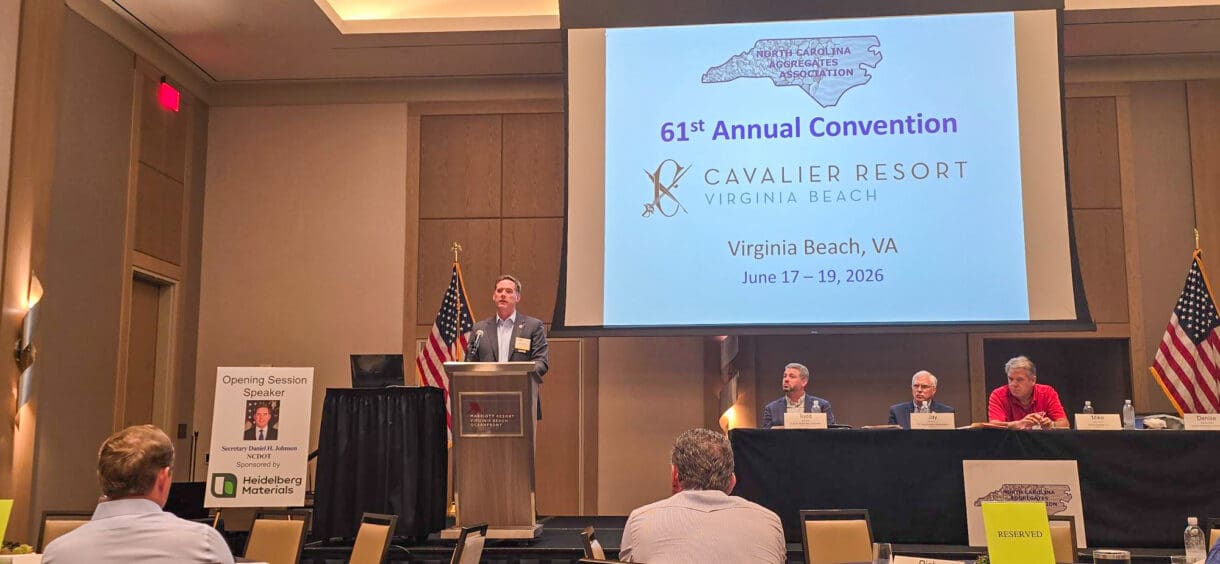
The North Carolina Aggregates Association’s 61st Annual Meeting in Virginia Beach brought together leaders across the aggregates, construction, and AEC industries to discuss the forces shaping our work today and the opportunities ahead.
I had the opportunity to participate in the conference’s AI panel, where the conversation focused on practical, immediate ways organizations are — and can begin — using artificial intelligence responsibly. That is what made the discussion so valuable. We were not talking about AI as some distant concept. We were talking about how it can help teams right now.
Finally. And that is exciting.
My fellow panelists, Brandon Hootman from Caterpillar and Travis Chewning from Luck Stone, did a fantastic job focusing on leveraging data and equipment innovations. In my opinion, those areas are fabulously focused and far ahead of the general public and, frankly, many of our businesses.
AI is already influencing how we gather information, use that information, manage workflows, and think strategically. If you do not use AI, it will use you. For organizations in the AEC industry, the question is no longer simply, “Should we use AI?” The better question is, “How do we build the mindset, systems, and safeguards to use AI well?”
That is where the opportunity is.
I want to share four strategic takeaways from the panel discussion and broader conversations at the event that can help leaders and teams think more clearly about how to approach AI adoption in a practical, responsible, and forward-looking way.
1. Start with practical uses that remove friction from everyday work
One of the best ways to begin using AI is to start with the work that already slows teams down.
AI can help draft and refine emails, letters, agendas, procedures, meeting summaries, event plans, proposal language and assembly, SOQ content, and internal communications. It can also assist with document summaries, research, competitive intelligence, and early-stage brainstorming, provided users are careful about what information they share and intentional about asking for sources.
The key is to keep it simple, specific, and focused on the right data sources.
AI does not need to solve the most complex technical challenge on day one to create value. In many cases, the early opportunity is helping employees move from a blank page to a workable draft, organize scattered thoughts, or complete administrative tasks more efficiently.
That matters because the barrier to entry is often lower than people think. In many cases, we are the barrier. Fear, lack of bandwidth, and uncertainty are three of the biggest obstacles to adoption.
Start by asking Copilot, Gemini, Claude, or whatever enterprise-approved tool you use how to begin. You do not need to start with a complex model or a massive workflow overhaul. Start with one recurring task. Start with one better prompt. Start with one small improvement. Then build from there.
That is a real win.
For leaders, this matters because adoption often begins with confidence. When employees see AI help with something familiar, they are more likely to experiment, be curious, and begin seeing where it can support higher-value work.
However, leaders also need to figure out how to scale. We need to create tools that make entry easier, use more impactful, and adoption more practical across the organization. That is where meaningful ROI begins to take place.
2. Treat AI like an intern, not an expert
A helpful way to think about AI is to treat it like an intern.
Give your large language model focused direction. Provide context. Provide specific instructions. Ask follow-up questions. Review the work. Make corrections. Most importantly, keep humans in the loop throughout the process.
Large language models are powerful, but they are far from perfect. They are probabilistic models, meaning they generate responses based on the highest-probability patterns rather than true understanding. That makes them fast, useful, and sometimes impressively persuasive, but it also means they can — and will — be wrong, especially if they are not guided by us.
That part matters.
This is especially important when using AI for math, technical details, data interpretation, or client-facing materials. Some tools are getting better in specific environments, including Excel-based workflows, but human judgment still has to remain in the loop.
An old adage rings true: trust but verify.
One way to improve results is to use a clear prompting structure. There are many ways to define this, but I like the RISE+ approach that my friend and fellow AI connoisseur, Jigar Desai, PhD, PE, MBA, and Principal with ECS, coined:
ROLE – What specific role do you want the LLM to play? A Chief Strategy Officer is much different than a technical design professional.
INSTRUCTIONS – What do you want it to do?
SPECIFICS – What context, constraints, resources, or data sources should it use? This includes the outcome you are looking for.
EXAMPLES – What examples of outputs do you want to see?
+ – Keep iterating, refining, and making it yours. Human in the loop.
This is where AI starts to get useful quickly. You ask. It responds. You adjust. It improves.
The goal is to communicate clearly, thoughtfully, and with specificity while understanding the capabilities of the LLM. Like an intern, it needs guidance. The better the input, the better the output.
Garbage in, garbage out.
3. Build governance before AI scales across the organization
One of the discussion points from the panel was the importance of governance.
That does not mean organizations should discourage experimentation. It means they need clear guardrails.
Firms should have policies and procedures that help employees understand which tools are approved, how those tools should be used, what information can and cannot be entered, and how new AI platforms or third-party applications are vetted. IT needs to be closely involved in that process, along with leadership and other key stakeholders.
As a note, the American Council of Engineering Companies has resources that can help firms think through responsible AI usage, including policies, culture, confidentiality requirements, and client-related considerations.
Enterprise large language models are a simple way to use organizational data more safely, especially when they are tied to an operating platform your firm already uses.
Are you a Microsoft shop? Use Enterprise Copilot.
Are you a Google shop? Use Gemini.
These tools can use data within your associated tenant or network, creating a more protected environment for approved use.
If employees are using public tools without guidance, organizations may be creating risks they do not fully understand.
At WithersRavenel, our AI Steering Governance Committee helps evaluate tools, use cases, governance questions, and opportunities for responsible adoption. That structure allows us to keep learning while also protecting our people, our clients, and our work.
Governance is not the opposite of innovation. Done well, governance is what allows innovation to scale.
And as stated before, scale is the ultimate goal to maximize results.
4. Make AI adoption a culture, strategy, and investment priority
AI adoption is not just a technology issue. It is a culture issue.
Some employees are eager to experiment. Others are hesitant. Some are concerned about accuracy, job security, access, training, or simply finding the time to learn another tool. That range of reactions is understandable, especially in an industry where professional judgment, technical expertise, and trust matter deeply.
According to Deloitte’s 2026 Gen Z and Millennial Survey, nearly three-quarters of Gen Zs and millennials report using AI in their day-to-day work, up sharply from the year before. That tells us something important: adoption is already happening, whether we want it to or not. The real question is whether organizations are keeping pace.
But waiting for perfect clarity, perfect governance, or perfect process is not a strategy.
AI is changing extremely fast. Every day. Something that did not work well two months ago may work better today. A feature that seemed experimental last quarter may now be built into software teams already use. That pace of change means organizations need to stay engaged, avoid groupthink, and continue testing.
Reimagine the workforce. Reimagine business processes. What got us here will not get us there.
That speed is part of the challenge, but it is also part of the opportunity. In a fast-moving environment, the organizations that keep testing, learning, and improving are going to create separation.
So where are we going individually, as businesses, and as an industry?
Pick a path and live it.
Kyle Shannon, CEO of Storyvine, has shared insights about future outcomes based on the paths organizations choose in “The 7 Economies – Or, Things Are About to Get Weird.” There are no wrong paths, but I would advocate that we should be on the transformational side of the equation.
Again: use AI, or it will use you.
This is also where investment matters. Firms need people who understand the difference between probabilistic and deterministic models, who can evaluate where each type of tool fits, and who can bridge the gap between technology and the business.
At WithersRavenel, we are using computer science talent to help build agents and applications that support how our teams actually work. The technical knowledge matters, but so does the ability to understand our people, our projects, our clients, and our industry.
That connection is powerful.
The firms that benefit most from AI will not be the ones that chase every new tool. They will be the ones that reimagine how we do business, reskill our people, and bring in technology experts to connect technology to strategy, culture, governance, and real business needs.
Final Thought: AI rewards curiosity and discipline
The pace of AI change can feel overwhelming, but it also creates tremendous opportunity.
For the aggregates, construction, and AEC industries, AI can help teams work more efficiently, communicate more clearly, and spend more time on higher-value thinking. But those benefits will only be realized if organizations approach AI with both curiosity and discipline.
Curiosity encourages us to test, learn, and keep improving. Discipline reminds us to verify outputs, protect information, create governance, and align tools with strategy.
The data supports what many of us are already seeing in real time: AI adoption is moving faster than many organizations expected or are willing to understand. That does not mean leaders need to chase every tool. It means we need to create the conditions for responsible experimentation and reimagine our future.
Remember: What got us here will not get us there.
That is the challenge, and it is also the opportunity.
Let’s keep learning.
Let’s go where no one has gone before — together.




About the Author

Brock Storrusten, PE
Chief Strategy Officer
Brock serves as WithersRavenel’s Chief Strategy Officer, a nearly 500-person design firm headquartered in North Carolina, where he leads enterprise strategy, long-range planning, and growth initiatives.
As Chief Strategy Officer, he is responsible for corporate visioning, strategic planning and execution, market and economic analysis, mergers and acquisitions, partnerships, and new business models. His work emphasizes aligning strategy with changing economic conditions and business environments, market volatility, talent dynamics, and evolving client needs, with a particular focus on resilience and sustainable growth. He actively leads and advises on digital transformation, AI governance, and applied AI initiatives within WithersRavenel and the Engineering industry, balancing aggressive yet responsible adoption.
He serves as Co-Chair of the Business Applications for AI Focus Group within the ACEC National Technology Committee, where he contributes thought leadership on applied AI, governance, and the future of professional services.