

Written By:


Streams provide aquatic and riparian habitat, capture and convey stormwater runoff, move sediment, and recharge groundwater supplies. They support recreation, and even provide sources for drinking water and navigable waterways for commerce if they are large enough. Stream restoration seeks to renew and protect these valuable resources and functions in places where they have been disrupted and degraded by environmental and anthropogenic changes.
What is stream restoration?
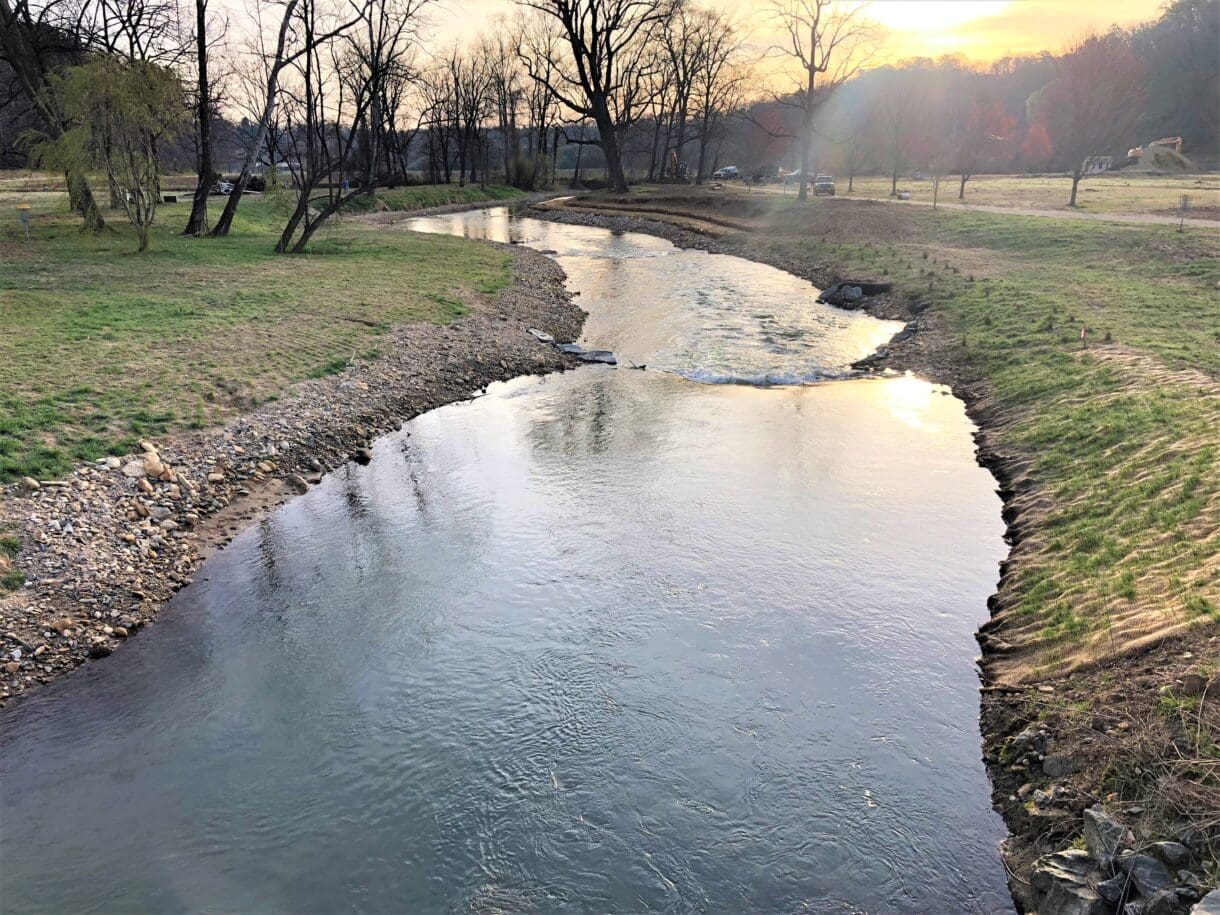
Stream restoration is the process of returning a stream and its riparian buffer to a state of improved environmental function and health. Stream restoration also typically involves:
- mitigation of negative impacts such as uncontrolled stormwater runoff and other sources of pollution, and
- re-establishment of native plant and animal species.
It may include the installation or modification of structures that improve and promote aquatic passage for fish, macro-invertebrates, and other aquatic life. This approach promotes ecological health by offsetting human interventions like dams, culverts, and bridges. Rather than removing them outright, these efforts enhance natural conditions.
Stream restoration typically does not include enhancements to stream navigability, such as dredging, unless those enhancements also support environmental health.
Read: WithersRavenel adds stream restoration services
Why is stream restoration important?
Natural and human events can cause stream impairment and adversely affect water supplies, ecology, and safety. Stream restoration can mitigate these changes, improve resilience to future impacts, and provide the following benefits:
- Improved water quality – Healthy riparian buffers, wetlands, and streams can filter and treat contaminants from surface runoff and other sources before they impact surface waters and aquifers downstream.
- Increased biodiversity – In addition to nurturing a variety of fish, amphibians, insects, birds, mammals, and plants, streams can connect fragmented habitats, providing species with easier access to food and shelter than might otherwise be available.
- Reduced flooding frequency and severity – Wide riparian zones and low, accessible floodplains provide a buffer between streams and infrastructure and provide storage areas for floodwater, reducing flooding risks.
How is stream restoration accomplished?
There are multiple approaches to stream restoration. Two popular ways to describe these approaches are form-based restoration and process-based restoration.
Form-based restoration
Form-based restoration focuses on the physical properties of the stream itself and how these contribute to stream function. The goal of form-based restoration is to alter the stream’s shape to achieve the desired water level, velocity, habitat, and turbulence. These factors in turn affect channel stability, streambank stability, and suitability as habitat for native species that should inhabit the stream and riparian zone.
Form-based restoration includes directly modifying the stream’s shape through modifying the channel, banks, and floodplain shape by installing in-stream structures, stable banks, floodplains, wetlands, and native plantings.
Benefits of form-based restoration
Benefits to a form-based restoration approach include:
- Access to information – Because many regulatory agencies have adopted form-based restoration, there are several national and state manuals addressing the topic. Stream restoration designs of this type are widely documented, providing models for future projects.
- Timeline – Form-based restoration can produce results more quickly than process-based restoration. Restoration efforts are not as dependent on seasonal, annual, or climatic changes in the environment. Restoration efforts may be expedited if materials and labor are readily available.
- Scalability – Form-based restoration can apply similar solutions, like installing in-stream structures, in one or many locations. This flexibility can make it possible to make improvements iteratively, as resources become available, providing continuous incremental improvements in environmental health.
Drawbacks of form-based restoration
There are also potential drawbacks to a purely form-based restoration approach:
- Aesthetic biases – Because many human-made structures tend to be linear, symmetric, and “organized,” some people believe streams should look a certain way without considering the natural processes that lead to a streams appearance in the landscape. Appropriate assessment and use of applicable reference information should be considered when designing a restoration project.
- Overcorrection – In an effort to increase stream stability, form-based restoration may prevent naturally occurring stream migration. In some cases, overhardening or trying to lock a stream in place can prevent riparian habitats from renewing themselves and discourage biodiversity. A analogy can be made with respect to fire management: large, frequent, and uncontrolled forest fires can devastate habitats and environs, while a total absence of fire can discourage healthy undergrowth and biodiversity, allow non-native invasive plants and other pests to flourish unchecked, and allow accumulation of tinder that allows for more devastating events. As with fire management, a balanced approach with clear restoration goals provides the best chance of success.
- Lack of proportionality – Form-based restoration efforts often tend to focus on specific areas of bank erosion or flooding. While these issues can be localized, their causes are often farther reaching, reflecting broader problems such as changes in land use and hydrology within the watershed and inadequate stormwater management. Attempts to fix systemic problems with narrowly focused targeted solutions may simply push the problem to a new place instead of solving it.
Process-based restoration
Process-based restoration focuses on natural processes that should occur, like reconnection of streams with their floodplains to restore hydrological and geomorphological processes. Goals address causes that have or are currently impairing the stream. As a result, this approach allows it to return to a more naturally functioning state.
Process-based restoration can involve removing or modifying human-made structures such as dams, weirs, culverts, and levees from streams and their floodplains and drainages. When structures cannot be removed in their entirety, restoration and enhancement efforts can shift to how structures can be modified to simulate more natural conditions. For instance, this might mean implementing controlled releases from dams or pretreatment of agricultural or urban runoff before it enters streams.
Process-based restoration commonly advocates for creation of riparian corridors around streams where development does not occur. These buffers or minimum setback distances prevent structures from being impacted by natural stream migration and provide space and opportunity for stormwater filtration, nutrient and pollutant uptake, and increased habitat.
Benefits of process-based restoration
A chief benefit of process-based restoration approach is the holistic approach. Process-based restoration acknowledges that streams, rivers, floodplains, and development are not discrete units interacting transactionally but elements of an interrelated whole. The “process” asserts that systemic problems require systemic solutions. It strives to avoid aesthetic biases and a tendency toward overcorrection by returning to the question, “What should this stream be doing?”
Challenges to process-based restoration
Challenges to the process-based restoration approach include:
- Timeline – Impaired streams aren’t created overnight. Process-based restoration takes time and cannot be expected to solve all problems immediately either.
- Complexity – Process-based restoration typically integrates multiple professional disciplines whose work may interact in ways that are difficult to model and predict. It may also involve more than one jurisdiction or regulatory agency, requiring a level of coordination and agreement that can be difficult to achieve, particularly if private landowners are affected.
- Conflict with development – Most structures built in floodplains are not purely for pleasure or recreation but serve needed functions for human development. For instance, dams create reservoirs, provide irrigation, control flooding, and generate electric power; apart from the financial cost, removing dams forces communities to seek other methods to achieve these goals, which may be difficult or expensive given the community needs and location. Accepting that natural streams migrate and carry vital sediment, and therefore development in their vicinity should be limited, may make sense when deciding where to build houses. This could lead to more difficult decisions when considering the need for structures that rely on the stream or river’s water or flow for their existence.
The bottom line
Stream restoration should strive to balance environmental health and human needs and development to achieve improved water quality, appropriate biodiversity, ecology, habitat, and flood prevention goals. Form-based and process-based restoration both have their place and their challenges, and elements of each may provide the best approach to a project. It is important to work with qualified environmental scientists, hydrologists, geologists, and engineers who will create restoration plans that consider the variety of factors that compete for the resource. They should also develop solutions that adhere to regulations and provide the greatest benefit to all.
Questions? Contact Our Experts


You Might Also Like ...

Stream Restoration Projects
About the Author
Joel Lenk, PG